
The whole market now says "thermal-break aluminium." It has become the floor, not the difference. The real step up is the system era — where a door or window is engineered and tested as one complete unit, not assembled from parts.
Each generation solved the last one's weakness. The 3.0 system era is where the frame stops being a set of parts and becomes a single, engineered whole.
A 系统门窗 — a system door and window — is designed as one matched set: the aluminium profile, the glass unit, the hardware, the gaskets and the drainage are engineered and tested to work together, to defined performance grades.
"Thermal-break aluminium" describes one component. It says nothing about whether the glass, seals, hardware and drainage were designed for each other — or simply bought and bolted together on site.
That difference is what a homeowner actually feels: quieter rooms, a cooler home, no draughts, no leaks, and hardware that still operates smoothly years later.
Both start with an aluminium frame. The real difference is how much of the window is actually engineered — one insulating strip, or every part working together.
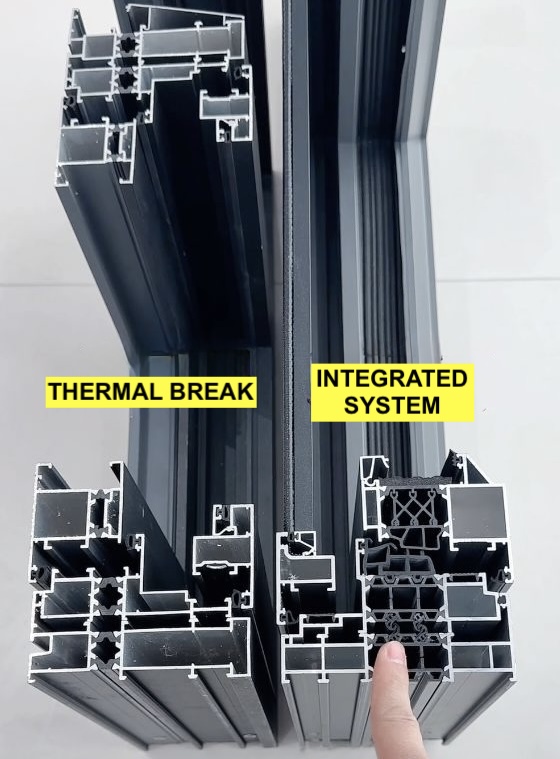
A band of low-conductivity material is set inside the aluminium to slow heat passing through the metal. It's a real improvement — but it solves one thing.
Every part is designed and tested together — so the frame doesn't just resist heat, it manages air, water, noise and security as a single unit.
"System window" has become a marketing label anyone can print on a quote. A genuine 系统门窗 shows it in the frame. These are the seven things to look for — on site, before you sign.
A single, unbroken insulating line running through the frame — wide and multi-chambered, not a short strip patched into the metal.
Real systems fill the corner joints with adhesive after assembly. Look for the small injection points — corners held by screws alone loosen over time.
The chambers inside the profile should be filled with insulating material, not left hollow — that's what actually slows heat and noise.
Three lines of resilient rubber — an outer rain guard, an airtight middle, an inner seal. Press them; genuine seals spring back, brittle ones don't.
Water should exit through internal sloped channels, not visible holes drilled across the face — which also keeps insects and draughts out.
Structural ribs inside the frame carry wind load — important for high floors. Screw-fixed mullions alone are a sign of assembled, not engineered, construction.
Hinges, handles and locks designed as part of the system — not a mix of whatever was cheapest. That's what keeps them operating smoothly for years.
The best test of a system window is whether the supplier can point to each of these in front of you. At our Experience Centre, come and feel the difference yourself.