
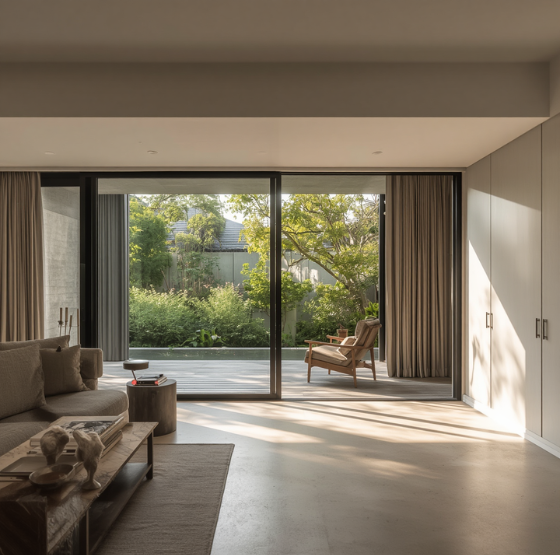
Most renovation decisions about windows start with how they look. Just as important is how they open — because the opening type decides how much air you get, how much view, how well the window seals, and how it feels to use every day.
Why the opening type matters
An opening type is not just a style. It changes the amount of ventilation you get, whether the window intrudes into the room, how large the glass can be, and how tightly it seals when shut. Get it right and a room breathes and feels effortless; get it wrong and you live with a daily small friction.
The three main types at a glance
Sliding
Panels glide sideways along a track and never intrude into the room. Best for space-saving and uninterrupted views.
Casement
Swings open on hinges like a door. The whole opening clears — the best sealing and airflow for its size.
Lift-and-slide
A handle lifts the panel off its seals to glide, then drops it to seal tight. For very large, heavy openings.
Sliding systems
Sliding panels move sideways along a track and never intrude into the room — which makes them the natural choice where space is tight or where you want an uninterrupted line to a view or balcony. Larger sliding doors carry real weight and wind load, so this is exactly where an engineered system, with reinforced profiles and smooth hardware, shows its worth.
Casement systems
Because the sash presses against the seals when closed, casements typically offer the best sealing and the most airflow for their size — you get the whole opening, not half of it. The trade-off is that they need clear space to swing, and on high floors the airflow can be strong.
Lift-and-slide systems
Lift-and-slide is the premium answer for large openings. The mechanism lifts the panel off its seals to glide effortlessly, then drops it back to compress the seals tight when closed — very large panels that still move with one hand and seal firmly against rain and noise.
Room by room
| Room | Usually best | Why |
|---|---|---|
| Living room / balcony | Sliding or lift-and-slide | View, space and a seamless opening to the outside |
| Bedrooms | Casement | Maximum fresh air and the quietest seal |
| Kitchen | Casement | Ventilation; easy to open over a counter |
| Bathroom / service | Top-hung / small casement | Privacy and rain protection while ventilating |
| Study / home office | Casement or fixed picture | Quiet, with a section that opens for air |
You usually should mix types across a home — casements where you want air, sliding or lift-and-slide where you want view and space. Keeping them within one system range keeps the look and performance consistent.
The system underneath matters most
A casement, a slider and a lift-and-slide can all be genuine system windows, or all be assembled aluminium. The opening type decides how the window suits the room; the system engineering underneath decides how well it performs and how long it lasts. Choose the type for the room, then insist on the system for the home.
Not sure what suits each space? Our Build Your Home planner walks through your home opening by opening and suggests the right system for each.
Key takeaways
- The opening type sets ventilation, view, sealing and how the window feels day to day — not just how it looks.
- Sliding saves space and frames a view; casement gives the best airflow and seal; lift-and-slide handles very large openings.
- Mixing types room by room is normal and usually best — keep them within one system range for consistency.
- Whichever type you choose, the engineering underneath decides performance and lifespan.