
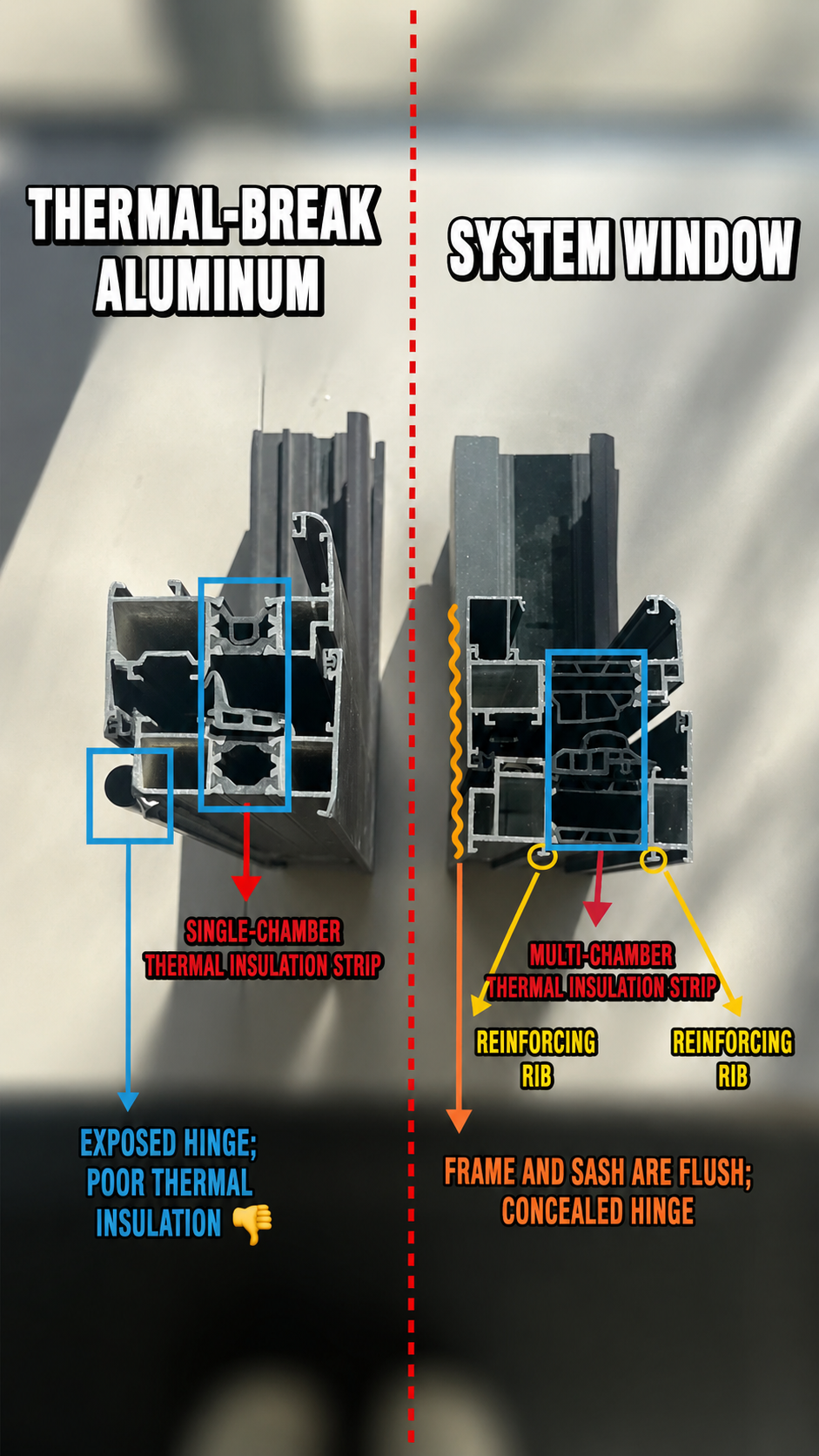
Walk through any renovation showroom in Singapore and you will hear the same two words on every quotation: system window. It has become the default label — which is exactly why it no longer tells you much. Almost anyone can call a thermal-break aluminium window a “system” window. Very few can show you why it actually is one.
Why the label stopped meaning anything
The distinction matters because it is the difference between a window assembled from parts bought separately and a window engineered as one complete unit. The first can look identical on day one and quietly fail over the years — draughts, water seeping in during a storm, hardware that stiffens, noise that was supposed to stay outside. The second is designed, tested and warranted as a whole.
There is no rule stopping a supplier from printing “system window” on a quote for ordinary thermal-break aluminium. So the word on the page cannot be your test. The frame itself has to be.
A thermal break is one part — an insulating strip inside the aluminium. A system is the whole window engineered together: profile, glass, seals, hardware and drainage, designed and tested as a matched set. Every system window has a thermal break; not every thermal-break window is a system.
Thermal break vs system, side by side
Here is how the two compare on the things you will actually live with.
| What matters | Thermal-break aluminium | Integrated system 系统门窗 |
|---|---|---|
| Thermal break | Single, narrow strip | Wide, multi-chamber |
| Corners | Screwed together | Injected & glued |
| Insulation cavities | Often hollow | Filled |
| Sealing | Usually single line | Triple-layer |
| Drainage | Exposed holes | Concealed, sloped |
| Reinforcement | Screw-fixed mullions | Built-in ribs |
| Hardware | Sourced separately | Matched to the system |
| Tested & warranted as | Individual parts | One complete unit |
The seven checks you can do on site
You do not need to be an engineer. Each of these you can see or touch — ask to see a cut cross-section and go down the list.
The single best test is simply this: ask the supplier to point to each of the seven in front of you. A genuine specialist keeps cut samples and is glad to. Reluctance is its own answer.
A thermal break is a part. A system is the whole thing, engineered together.
What it costs you to get this wrong
The gap between the two does not show on day one. It shows the first time a storm drives rain sideways into the frame, the first humid month when a hollow profile sweats, the first year the hardware starts to drag. By then the cheaper window has often already marked the wall around it — and the saving is spent several times over on repairs.
If you want to see all seven side by side — a thermal-break profile and a full system profile, cut open on the same table — that is exactly what our Experience Centre is for. And when you are comparing quotes, our guide to the hidden costs homeowners miss shows how the same gap hides inside a price.
Key takeaways
- “System window” is a label anyone can print — judge the frame, not the quotation.
- Seven checks tell the difference on site: continuous thermal break, glued corners, filled cavities, triple sealing, concealed drainage, built-in reinforcement, matched hardware.
- A real system is tested and warranted as one unit; assembled aluminium is a set of separately-sourced parts.
- The difference is invisible on day one and unmistakable a few tropical years later.